
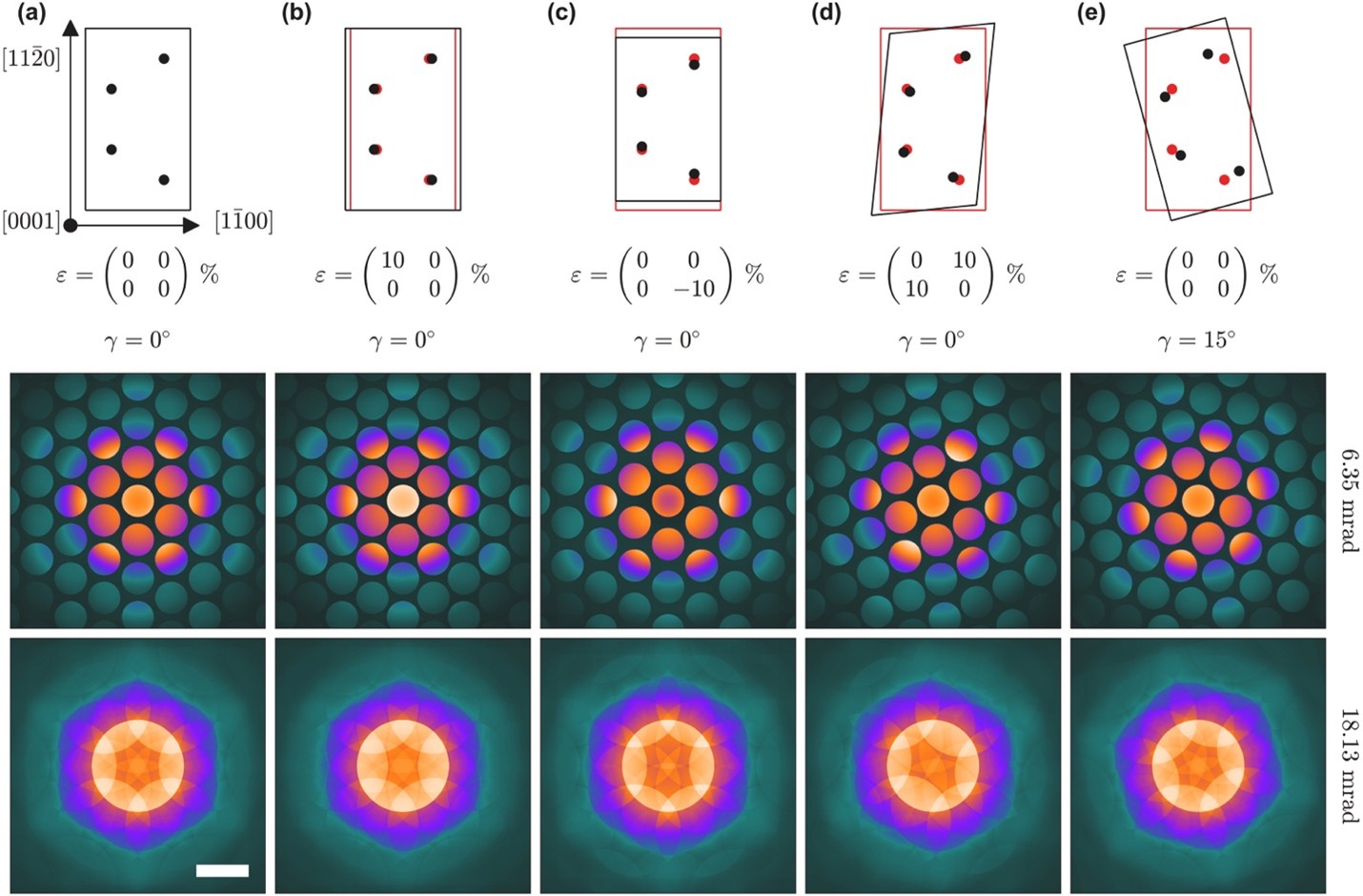
Atomic models of MoS2 and simulated PACBED patterns for five different strain tensor and rotation cases. For each case, the top panel illustrates the deformed unit cell (black) relative to the original unit cell (red) and specifies the strain tensor and rotation angle. The middle and bottom panels show the resulting PACBED patterns from a 10 layer thick sample for the 6.35 and 18.13 mrad convergence angles. The scale bar in the lower left panel corresponds to 20 mrad. (Ultramicroscopy 279 (2026) 114246)
Neural Network-Enhanced PACBED for Characterizing Deformations in 2D van der Waals Materials
Two dimensional (2D) van der Waals (vdW) materials have attractive properties that are highly tunable especially when they are thin. However, they are rarely perfect and flat, and their properties are strongly influenced by local crystal lattice deformations, which can be described by a combination of the 2D strain tensor, in-plane crystal rotation, and sample corrugation state. Conventional electron microscopy-based strain measurement methods have been invaluable for understanding local strain variations within many materials. However, they have several limitations, especially when what is desired are fast, highly accurate, atomically resolved measurements of the complete deformation state over a large field of view.
To help overcome these limitations, we have developed a method of combining position averaged convergent beam electron diffraction (PACBED) and convolutional neural networks (CNNs) for determining deformations of 2D materials. We performed a comprehensive simulation study of the methods performance to help aid the optimal design of future experiments. From a single PACBED pattern, the method is capable of simultaneous, direct, robust and fast measurements of the full 2D strain tensor, in-plane crystal rotation, and sample corrugation state. There is a tradeoff between better performance (smaller error) and finer spatial resolution. Impressively small strain error, down to ~0.0003%, can be achieved using nano-sized electron probes, while even with atomic-scale electron probes, the strain error can be as low as ~0.001 %. The method is robust across a range of sample thicknesses (here ranging from 2 to 20 layers), except for monolayers. The poor CNN performance from monolayers is studied and understood. Two remedies for overcoming this limitation are demonstrated. We envision this work will help enable fast real-time 4D STEM mapping of the deformation state of 2D materials at atomic resolution, beyond what is possible with the current conventional analysis methods. Additionally, the method could be extended beyond 2D materials to 3D crystalline materials, broadening the impact.
The work was carried out by Andrew Yankovich and Eva Olsson at Chalmers University of Technology in collaboration with Magnus Röding (Chalmers and AstraZeneca), and has recently been published in Ultramicroscopy, Volume 279, 114246, 2026.