
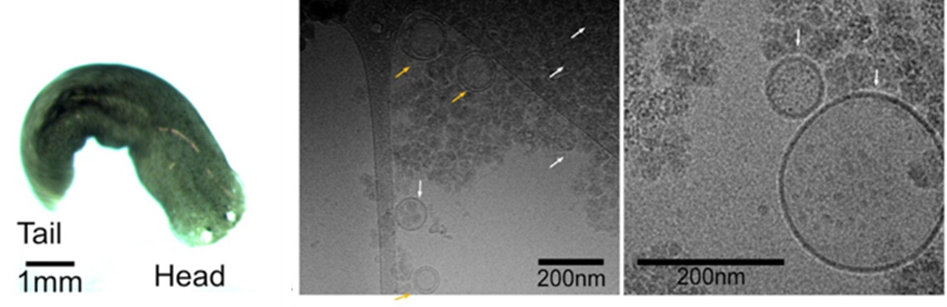
(Left) Flatworm showing characteristic head and tail region. (Middle) Cryo-TEM image showing EVs extracted from the flatworms with either single layer or double layer membranes (white and orange arrows respectively). (Right) dark spots inside the EVs indicate the existence of encapsulated biomolecules.
Cryo-TEM of extracellular vesicles derived from flatworms.
Vesicles fall into the category of “soft matter”, being made up of largely organic material and existing in an aqueous environment. They are nanoscale sacs that consist of a fluid surrounded by a lipid bilayer, and are best imaged using a cryo-TEM, such as the 200kV JEM 2200FS in Lund. A grid with a thin layer of the liquid is rapidly frozen and transferred to the TEM where the vesicles or other nano-structures are observed within the vitreous “solid water” layer using low dose techniques.
While most soft matter investigated within the ARTEMI scheme at Lund is synthetic in origin, some materials derive from biological systems and that includes the structures shown here. These are extracellular vesicles (EVs) which come from flatworms found in a park in Malmö. These flatworms (see figure) have an extraordinary regenerative capacity and initial indications indeed show that these EVs accelerate wound healing in human skin model samples. Cryo-TEM was used to investigate the size of the vesicles, the nature of the lipid bilayer membrane and the content of the vesicle (see figure).
The TEM work was carried out by Crispin Hetherington at nCHREM, the ARTEMI node in Lund University. It was a collaboration with Martin Hjort and Rakel Bjurling in Chemical Biology and Therapeutics, and others. The findings were reported in Aftonbladet and other papers and the full report can be found in ACS Omega 2026, 11, 20683−20690.