
Three New PhD Theses Advance the Field of Electron Crystallography
Three recently defended PhD theses at Stockholm University have developed different aspects of electron crystallography, including advancements in terms of methods as well as structural analysis.
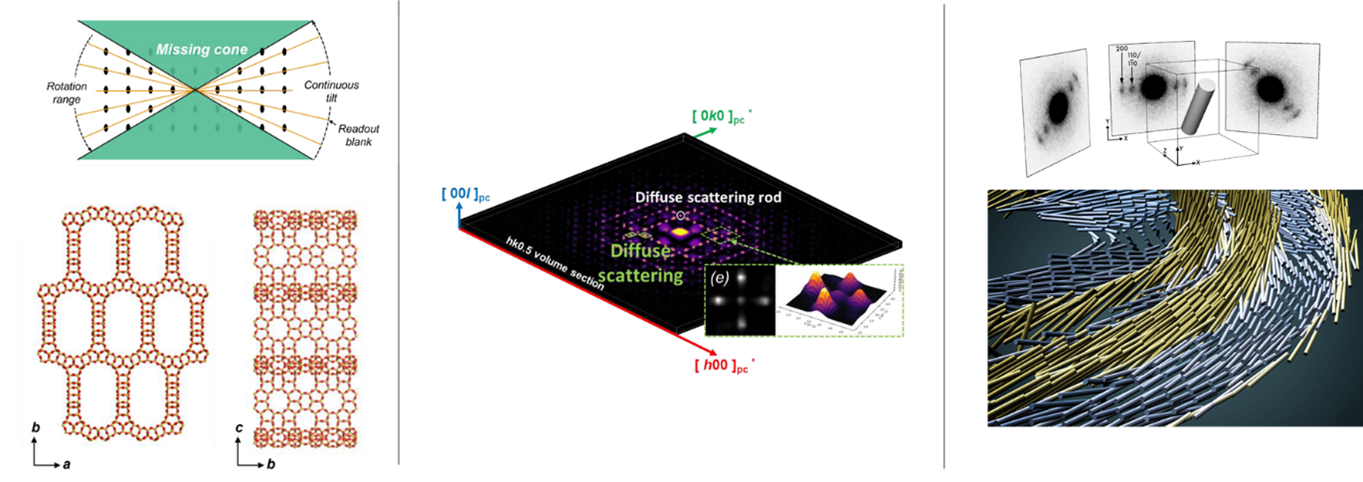
Three-dimensional electron diffraction (3D ED) has evolved to a powerful method for structure determination of nano-/micron-sized crystalline materials. Dr. Jiaoyan Xu has adapted the method to studies of electron beam-sensitive materials such as pharmaceuticals, zeolites, and metal-organic frameworks (MOFs). In her thesis, she determined the structure of ZMQ-1, the first stable meso-microporous aluminosilicate zeolite. Not only was the framework determined, but also the organic structure-directing agent molecules in the pores of the material were resolved using 3D ED.
(https://urn.kb.se/resolve?urn=urn%3Anbn%3Ase%3Asu%3Adiva-241607)
The pair distribution function (PDF) is a tool for structure analysis of atom-pair correlations and is especially powerful for studies of materials lacking long-range order. Dr. Shihui Feng has developed methods for electron-based PDF (ePDF), which enables local structure analysis at the nanoscale. He obtained angular-resolved atom-pair correlations and adapted both the three-dimensional PDF (3D-PDF) and its difference counterpart (3D-ΔPDF) to TEM. He studied, e.g. piezoceramic perovskites, where both in-phase and antiphase octahedral tilts were quantitatively measured and A-site cation displacements were resolved.
(https://urn.kb.se/resolve?urn=urn%3Anbn%3Ase%3Asu%3Adiva-241788)
Scanning electron diffraction (SED) is an emerging method for studies of the crystalline ordering of soft matter such as polymers. Dr. Mathias Nero has used SED to analyze the nanoscale organization of structural polysaccharides in both natural and synthetic composite materials. By combining the acquisition of SED data at several different tilt angles, he developed a new method to reconstruct the 3D orientations of polysaccharide nanofibrils. These results revealed the chiral organization in the cell wall of plant cells, revealing alternating chiral handedness of the fibrillar organization.
(https://urn.kb.se/resolve?urn=urn%3Anbn%3Ase%3Asu%3Adiva-245492)