
PtBi Alloys with Engineered Crystallinity for Spin Hall Nano-Oscillators
The efficient control of magnetization via spin–orbit torque (SOT), primarily generated by the Spin Hall effect (SHE), lies at the core of modern spintronics. Pt is an important material choice with strong SHE. Tuning of the SHE in Pt can be realized using lighter impurities, such as S, O, N, and P. However, such tuning requires careful materials engineering and often comes with a trade-off in the form of increased resistivity. Recently, it has been found that light metals, such as Bi, can be used to tune SHE in Pt while maintaining its low resistivity. Supported by an ARTEMI user project, the Applied Spintronics Group at Gothenburg University worked with the Chalmers node in ARTEMI, systematically studied the effect of structure engineering of PtBi alloys on the SHE.
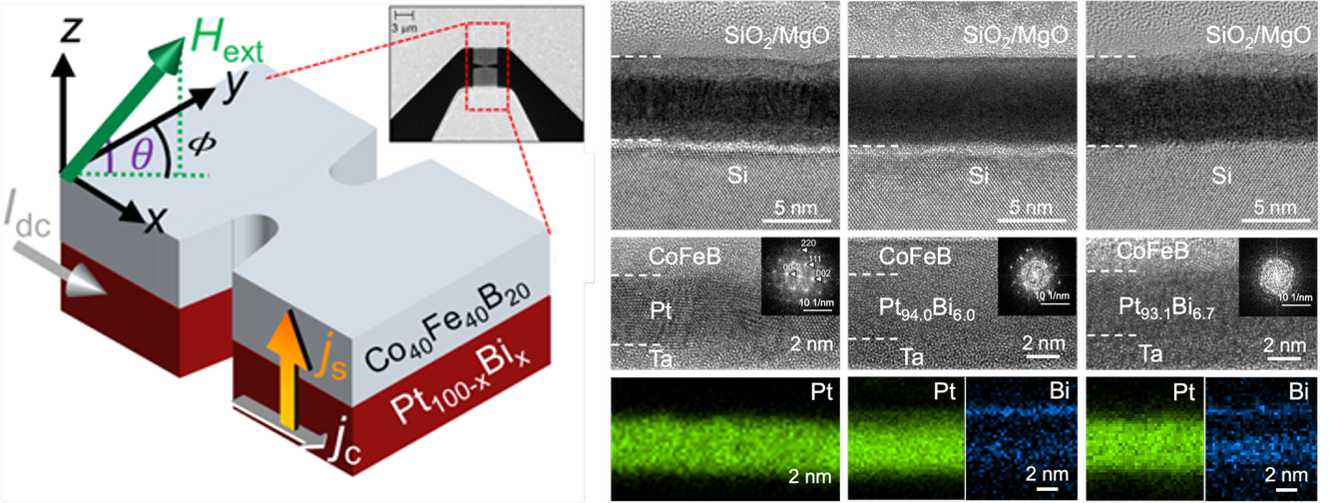
A series of PtBi alloys with tuned Pt/Bi composition in a thin film architecture were studied. In the Pt100.0Bi0.0, high resolution TEM (HRTEM) images and the corresponding diffractogram show a polycrystalline structure of the nanometre thick Pt layer. After introducing Bi in the Pt layer, PtBi alloys exhibit more disordered lattice structure, evidenced by disordered lattice fringes in HRTEM as well as diminished Bragg spots and higher-order rings in the diffractogram. As Bi concentration increases, the crystallinity of PtBi further decreases. STEM-EDXS elemental maps show that Bi is uniformly distributed throughout the target Pt layer, with no sign of clustering. An enrichment of Bi is also observed at the Pt94.0Bi6.0/Co40Fe40B20 and Pt91.3Bi8.7/Co40Fe40B20 interfaces. Device property measurements show that Bi doping in Pt enhances SHE by over 3-fold while largely. The structural modifications introduced by Bi doping are believed to play an important role in the enhanced spin transport properties of the structures.
The correlative study of structural measurement using TEM and device performance measurement provided critical information for the further development of spintronics. The results from the project are published in ACS Appllied Materials and Interfaces 18, 39941 (2026).