
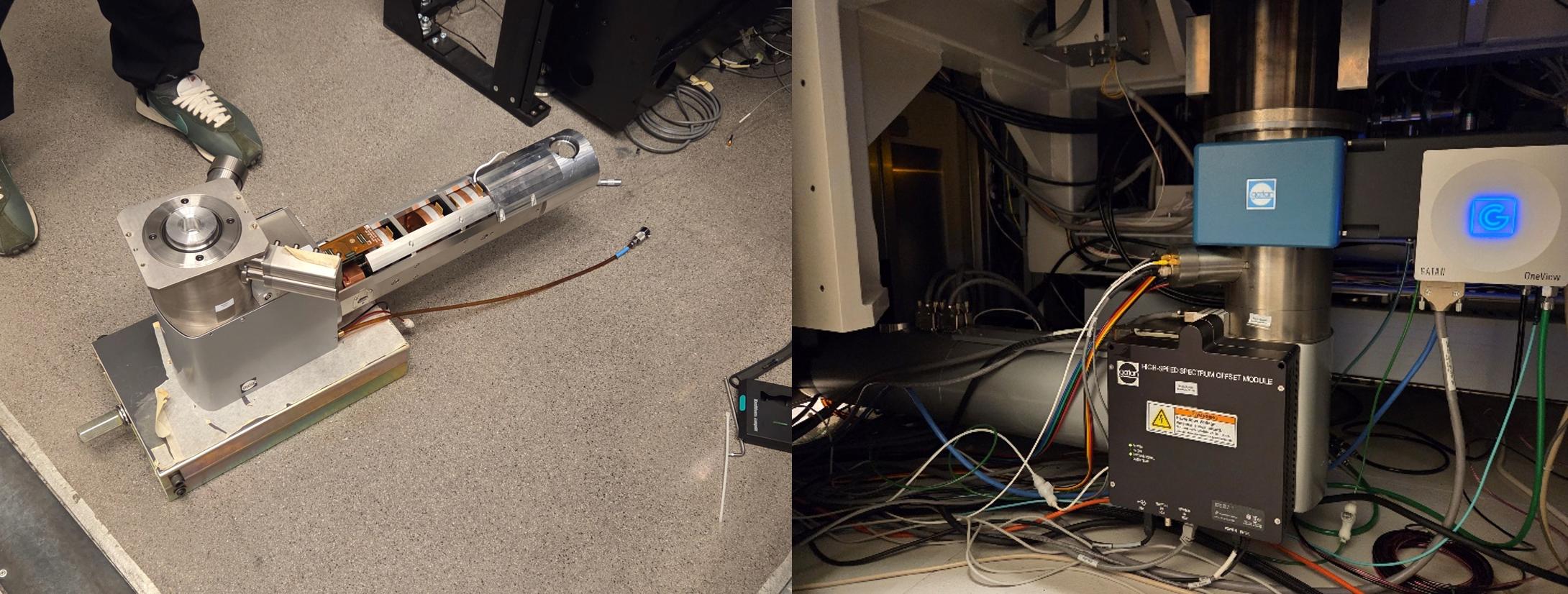
Figure 1. Left: the Gatan Quantum ERS after removal from the Titan ‘Arwen’ in Linköping in December 2025. Right: installed on the Hitachi HF3300S ETEM in Lund, where it is now operational and available to ARTEMI users. Photo: Daniel Madsen
From Linköping to Lund: Quantum EELS Spectrometer Gets a Second Life
A high-end spectrometer does not necessarily have to retire just because its microscope does. A Gatan Quantum ERS system from the decommissioned TFS Titan “Arwen” in Linköping has now been recommissioned on the Hitachi HF3300S environmental TEM in Lund, giving the instrument a second life – and ARTEMI users access to new analytical capabilities.
Transmission electron microscopes and their analytical equipment represent major investments, so making the best possible use of existing instrumentation is important. ARTEMI not only gives researchers access to leading electron microscopy laboratories across Sweden; the infrastructure also creates opportunities for its laboratories to share expertise and equipment. The recent transfer of an electron energy-loss spectrometer from Linköping to Lund is a good example.
Before the TFS Titan “Arwen” was taken out of service in Linköping in December 2025, its Gatan Quantum ERS imaging filter and EELS spectrometer was carefully dismounted and packed for transport. During spring and summer 2026, the system was installed on the Hitachi HF3300S environmental TEM at Lund University. It has now been brought back into operation and is once again delivering spectroscopic data to users through ARTEMI.
Electron energy-loss spectroscopy, or EELS, measures the energy lost by electrons as they interact with a specimen. In addition to identifying and quantifying elements, EELS can provide information about their chemical state and bonding, making it a powerful complement to energy-dispersive X-ray spectroscopy (EDS). On the Lund environmental TEM, this is particularly valuable for in situ experiments, where structural and chemical changes can be followed while a material is heated or exposed to gases. Lund’s EELS project specifically highlights possibilities such as following changes in oxidation state during redox experiments and performing compositional analysis at high temperatures.
The new combination therefore adds another analytical dimension to an instrument already designed for dynamic experiments. The HF3300S is an environmental TEM equipped for controlled gas experiments and heating and has been used extensively for atomic-scale studies of processes such as III-V semiconductor nanowire growth.
For ARTEMI, the transfer is also a practical demonstration of what a distributed national infrastructure can achieve: valuable equipment and expertise can be redeployed where they create new scientific opportunities, rather than being lost when an individual microscope reaches the end of its service life.